
- Details
- Hits: 956
“Global researchers are saying that today’s cannabis, is the singular most important link to youth mental health illness epidemic we have in this country.” [USA]
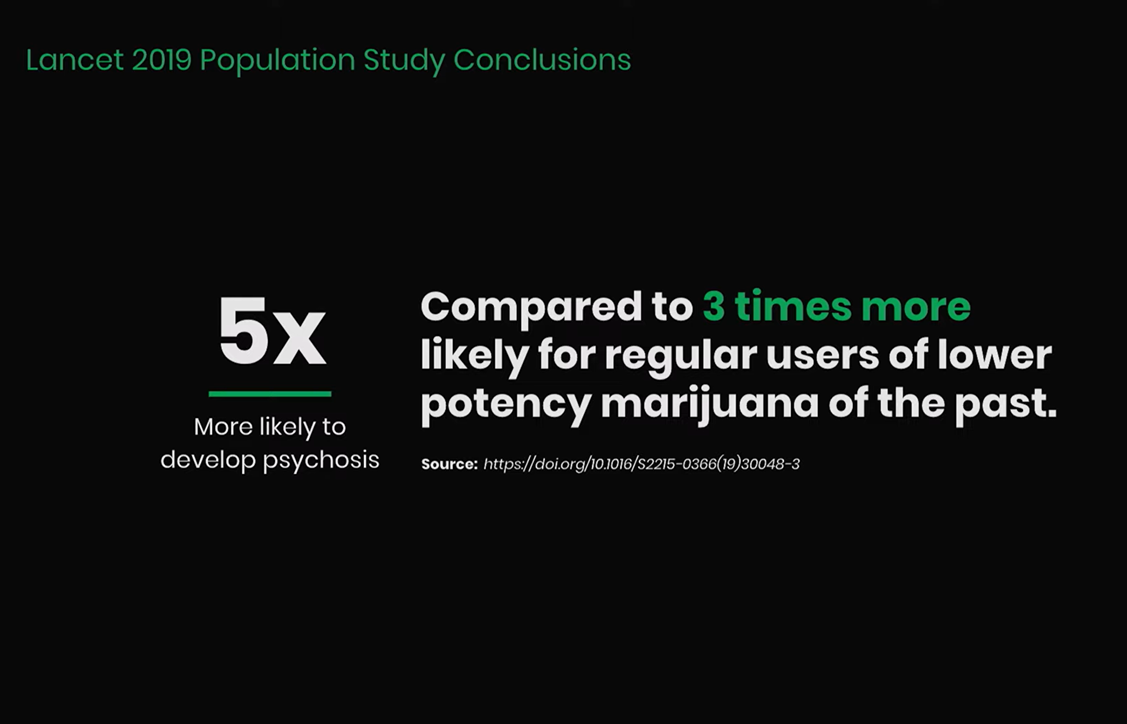 Marijuana companies are using the same manipulative tactics used by tobacco companies of the past. In fact, it’s the same exact playbook: advertising the product as medicine, using child-like messaging, and targeting people of color. Decriminalizing marijuana, for example, is important in getting closer to social justice equity, but that narrative often gets conflated with legalization and glamorization. Kevin Sabet Ph.D, President & CEO of Smart Approaches to Marijuana, sheds light on the detrimental societal impacts of marijuana and unveils the truths obscured by its glamorized portrayal.
- Details
- Hits: 814
Research team discovered that individuals who used cannabis long-term (for several years or more) and heavily (at least weekly, though a majority in their study used more than four times a week) exhibited impairments across several domains of cognition. Long-term cannabis users' IQs declined by 5.5 points on average from childhood, and there were deficits in learning and processing speed compared to people that did not use cannabis…The study also found that people who knew these long-term cannabis users well observed that they had developed memory and attention problems. The above findings persisted even when the study authors controlled for factors such as dependence on other drugs, childhood socioeconomic status, or baseline childhood intelligence.
The impact of cannabis on cognitive impairment was greater than that of alcohol or tobacco use. Long-term cannabis users also had smaller hippocampi (the region of the brain responsible for learning and memory). https://www.health.harvard.edu/blog/cognitive-effects-of-long-term-cannabis-use-in-midlife-202206142760
- Details
- Hits: 843
When Kalpit Sharma started smoking cannabis, he thought it was just part of "living his life" as a university student. After all, he had been told that the drug was relatively harmless.
That all changed in the summer of 2021, when he started hearing voices in his head.
"I would bike around, and the chain of the bike, it came off. And I thought that I could speak to birds, and birds were telling me how to put the chain back on," said Sharma, who was studying at York University in Toronto at the time.
Those voices are known as auditory hallucinations — a hallmark of psychosis. When they became more frequent and insistent, he went to the Centre for Addiction and Mental Health for an assessment.
Sharma was shocked when he was told that he had been exhibiting signs of psychosis — and eventually he was diagnosed with schizophrenia.
In 2023, Myran co-authored two studies looking into the connection between cannabis and psychosis. They found a 220 per cent increase in emergency room visits in Ontario for cannabis-induced psychosis between 2014 and 2021 — with the number rising from about 400 people to about 1,400 over that seven-year period.
"For men aged 14 to 24, the risk of developing schizophrenia rises to over 40 per cent within three years" of showing up in an ER for cannabis-induced psychosis, he said.
Myran was also lead author of a separate study released in early February that found 27.5 per cent of people who visited an emergency room for cannabis use developed an anxiety disorder for the first time within three years. For complete article including videos go to https://www.cbc.ca/radio/whitecoat/cannabis-induced-psychosis-bad-trip-1.7116217
RELATED STORIES
- 5 years of legal cannabis: fewer charges, many hospitalizations and more than a few questions
- 'The world has changed dramatically': 5 years of legal cannabis in northern Ontario
- The razzle-dazzle days of Canada's cannabis industry are over as pot industry faces downturn
- Cannabis use sending more pregnant Canadians to hospital, new study finds
- The pros, cons and unknowns of legal cannabis in Canada 3 years later
- Details
- Hits: 765
"It's just weed."
Spend enough time at parties or clubs and you will probably hear this phrase used in instances of peer pressure to use marijuana. But what this reassurance does not convey is that cannabis is four times as potent today as it was just three decades ago.
The amount of Delta-9-tetrahydrocannabinol (commonly known as THC) in marijuana seized by the DEA has spiked from 3.4% in 1993 to 15.34% in 2021.
Higher THC levels in marijuana are linked to increased problems with memory and learning, distorted perception, difficulty in thinking and problem-solving, and loss of coordination. Higher THC also exacerbates the effects associated with regular use of cannabis, including physical dependence and withdrawal following discontinuation, as well as psychological addiction or dependence.
Even more disturbingly, all too often, people are unaware that marijuana, especially when it contains more THC, is a risk factor for psychosis and schizophrenia, as well as the fact that it stunts brain growth, sometimes includes lead and mercury, and can alter male sperm DNA linked to autism.
Watch What Every Parent Needs to Know About Adolescent Substance Use – Danielle M. Dick PhD
(Source: Get Smart About Drugs FEBRUARY 16, 2024)
- Details
- Hits: 822
Development of an anxiety disorder following an emergency department visit due to cannabis use: a population-based cohort study
Interpretation: ED visits for cannabis use were associated with an increased risk of having an incident healthcare visit for an anxiety disorder, particularly in young males. These findings have important clinical and policy implications given the increasing use of cannabis over time and trend towards legalization of cannabis. (The Lancet)
Nearly a third of people who visited the emergency room for a cannabis-related concern developed a new anxiety disorder within three years, according to research released Monday.
The study—published today in The Lancet’s open access journal eClinical Medicine—is said to be the most comprehensive examination of the relationship between cannabis use and anxiety to date.
Canadian researchers examined the health records of more than 12 million people living in Ontario between 2008 and 2019 who had no record of an anxiety disorder, or of receiving treatment for one. Those who had an emergency room visit for cannabis use during that period were more than three times more likely to be diagnosed with a new anxiety disorder—at an outpatient visit, emergency room, or hospital—within three years, the study found. They were also nine times more likely to require another health care visit—an outpatient or ER visit, or a hospitalization—for an anxiety disorder down the road.
Young cannabis users—ages 10-24 and males, in particular—were at particularly elevated risk, researchers noted. (