
- Details
- Hits: 1805
The link between tobacco smoke and lung cancer is well-known. Studies show that marijuana smoke has many of the same harmful substances as tobacco, and often more of them. Among the hazards are:
- Benzo(a)pyrene
- Benz(a)anthracene
- Phenols
- Vinyl chlorides
- Nitrosamines
- Reactive oxygen species
People also smoke marijuana in a different way than tobacco, possibly posing greater danger to the lungs:
- You usually inhale marijuana smoke deeply and hold it in, which gives the toxins more contact with your lung tissue and more chance to stick there.
- You generally a smoke a joint all the way to the end. Tar, the sticky stuff left after burning, has high levels of harmful substances, and it’s concentrated at the end of a joint.
When scientists looked at lung tissue of some people who smoked weed regularly, they found changes that are known to signal the future growth of cancer. For complete article go to Does Marijuana Cause Lung Cancer? (webmd.com)
For more evidence based science on harms of Cannabis to lungs
- Details
- Hits: 1657
October 9, 2021
Legalising and commercialising cannabis is well underway from Uruguay to Canada and in at least 10 states in the US. Paradoxically, this shift towards the toleration of cannabis as more-or-less harmless is taking place just as scientists conclusively prove the link between cannabis and psychosis (a less shocking word than “madness” or “insanity”, but the meaning is the same). Cause and effect is today as well established as it is between cigarette smoking and lung cancer.
“Numerous prospective studies have shown that cannabis use carries an increased risk of later schizophrenic-like psychosis,” says an article by Sir Robin Murray of the Institute of Psychiatry, Psychology and Neuroscience at King’s College London and Wayne Hall of the National Centre for Youth Substance Use Research at the University of Queensland. They cite a study showing that, though Portugal is held up as a pioneer in dealing with drugs, the rate of hospitalisation for psychotic disorders has increased 29-fold since decriminalisation 15 years ago. Another study calculates that between 30 per cent and 50 per cent of new cases of psychosis in London and Amsterdam would not have occurred if the individual affected had not been smoking high-potency cannabis.
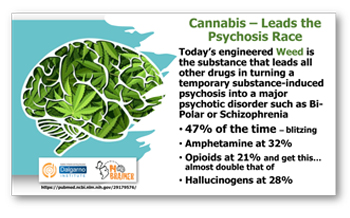
Personal observation confirms this: doctors in mental hospitals have told me that they scarcely bother anymore to ask patients if they have taken cannabis, but simply assume it is the case. The situation has deteriorated as the proportion of THC, the psychoactive substance in cannabis producing the “high”, has risen precipitately. Once as low as 3 per cent it has risen to 10 to 15 per cent in Europe and North America, though in Colorado, the first state to legalise recreational use, the THC can reach as high as 70 per cent. Those taking cannabis daily, particularly if they are young, face an escalating risk of permanent mental breakdown.
But if cannabis has already had its “tobacco moment”, when the damage it does is scientifically proven, why do celebrities like Justin Bieber want to destigmatise it and persuade consumers that it will improve their mental health?
The cigarette industry did this a century ago, funding “independent” experts that sought to blur or discredit evidence that smoking caused cancer. Governments were seduced by high tax revenues from tobacco sales and reluctant to do anything to curtail them. Hollywood stars like John Wayne, Clark Gable and Spencer Tracy happily – and profitably – glamourised cigarettes, much as is happening to cannabis now.
Businesses seeking to emulate the tobacco companies at the height of their profitability have formed a bizarre de facto alliance with liberals and progressives, who are appalled by the disastrous mess created by government drug policy. The so-called “war on drugs” has demonstrably inflicted more misery in the US, certainly on the black community, than real military conflicts.
But an over-reaction to government failure provoking a dash in the opposite direction has equal dangers. Those in favour of greater tolerance towards drugs are almost invariably thinking of cannabis as much less nasty than heroin and cocaine. But I have met psychiatrists, with long experience of dealing with drug victims of all sorts, who believe that cannabis is more dangerous than the other drugs because it has the potential to damage many more people.
The legalisation of cannabis will do nothing to hurt organised crime groups, but it will make the drug much more widely available. The idea by proponents of legalisation that the government will tightly regulate its quality and sale is naïve. If the authorities cannot control it when it is illegal, they will be even less able to do so when it is legal. But legalisation – and even limited decriminalisation – will send a message that taking cannabis is a benign activity and does not do you or anybody else much harm. The deterrent effect of illegality will evaporate and the drug becomes no different than alcohol and tobacco.
Once commercially available, all the old persuasive tools formerly used by the cigarette industry swing into action as is happening unstoppably in the US. Celebrities like Justin Bieber will “destigmatise” the drug and give it the gloss of youth and fashion. Once the victims of the tobacco companies coughed up their lungs unnoticed by the wider community, and this time round the victims of cannabis will disappear into mental hospitals without anybody taking much notice.
- Details
- Hits: 2047
(University of Birmingham) Posted on 01 Oct 2021
Those with a recorded history of cannabis use in general practice records are at a much higher risk of developing mental ill health problems such as anxiety or depression as well as severe mental illnesses, new research shows.
The findings point to the need for a public health approach to the management of people misusing cannabis, including the need to emphasise the importance of general practitioners to continue enquiring about recreational drug use.
While the links between cannabis use and severe mental illnesses such as schizophrenia and psychosis are well researched, the associations are less clear between cannabis use as described in patient’s GP records and other, more common types of mental ill health such as depression and anxiety.
In a new study, published in Psychological Medicine, researchers in the University of Birmingham’s Institute for Mental Health and the Institute of Applied Health Research found a strong link between general practice recorded cannabis use and mental ill health in one of the largest cohorts ever explored.
Senior author Dr Clara Humpston said: “Cannabis is often considered to be one of the ‘safer’ drugs and has also shown promise in medical therapies, leading to calls for it be legalised globally. Although we are unable to establish a direct causal relationship, our findings suggest we should continue to exercise caution since the notion of cannabis being a safe drug may well be mistaken.”
Dr Joht Singh Chandan said: “The research reaffirms the need to ensure a public health approach to recreational drug use continues to be adopted across the UK. We must continue to progress measures to improve the prevention and detection of drug use as well as implement the appropriate supportive measures in an equitable manner to prevent the secondary negative health consequences.”
- Details
- Hits: 1646
Public Health Significance—Dual use of alcohol and cannabis appears to be associated with adverse behavioral and psychological consequences and is a rapidly growing public health concern. This study suggests dual users have greater demand for alcohol, steeply discount delayed alcoholic drinks, and are at higher risk for alcohol use disorder than individuals who consume alcohol but do not consume cannabis.
The reinforcer pathologies model proposes 2 behavioral economic constructs interact in addiction: operant demand and delay discounting. These constructs manifest as behavioral markers of addiction in the form of excessive reinforcer value and strong preference for immediate access and consumption of this reinforcer despite suboptimal long-term outcomes. The first aim of this investigation was to identify the degree to which delay discounting (of money and alcohol) and demand for alcohol differ between college student drinkers (N = 185) who do and do not co-use cannabis. As a second aim, we sought to replicate the 2-factor solution for alcohol and cannabis demand within a college sample. Results suggest dual users have significantly stronger Persistence and Amplitude for alcohol, demonstrate steeper delay discounting of alcoholic drinks, and are at greater risk for alcohol use disorder than individuals who drink yet do not use cannabis. These results provide further support for the reinforcer pathologies model and contribute to the literature on dual-substance use in the college populationNude, G. P., Reed, D. D., Thornton, T. J., & Amlung, M. (2021). Dual use of alcohol and cannabis among college students: A reinforcer pathologies approach. Experimental and Clinical Psychopharmacology, 29(4), 407–417. https://doi.org/10.1037/pha0000369. (PsycInfo Database Record (c) 2021 APA, all rights reserved)