
Cannabis driving fatalities are a problem the research keeps flagging, and the flags are getting harder to ignore. Limit the data to lab confirmed drug use and drivers with cannabis in their system turn up more often among the dead and the injured.
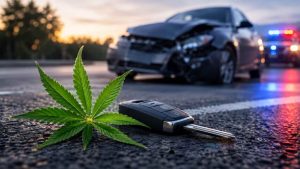 A 2025 systematic review in the International Journal of Drug Policy pooled 31 studies covering 328,388 people. It found a 55% rise in the odds of a fatal crash for drivers with toxicology confirmed cannabis use. The authors put the absolute increase at 14 more deaths per 100,000 collisions. For injuries, the odds doubled.
They rate that evidence as low certainty and say so openly. Low certainty means further research could move the numbers. It does not mean the danger is absent. The main analyses in this debate find added risk, though their authors disagree about how much, and one bias adjusted analysis by White and Burns finds none.
How many cannabis driving fatalities are there each year?
US researchers Kamer and Warshafsky estimate that cannabis related road deaths in America run to about 5,000 a year. That number has been disputed. A commentary by Michael White in the same journal spotted two input errors. The estimate used a wider count of motor vehicle deaths than the traffic count it was meant to cover, and it treated an odds ratio as a relative risk. Fixing both cut the figure to about 3,550.
White then took out every driver who was also over the 0.08 alcohol limit. Using risk values from published meta analyses, his tables still give between roughly 1,800 and 3,200 deaths a year. These are modelled estimates, not a head count, and he stresses the uncertainty. But even his lowest conventional figure is around 1,800 deaths annually.
The roadside data adds weight. US figures cited by White show THC in about 32% of driver fatalities, although roughly 40% of the THC positive drivers were also over the alcohol limit. Sorting out which substance did what is hard. Pretending the cannabis share is zero is harder.
Even the sceptics won’t call it safe
Ole Rogeberg’s 2019 analysis of culpability studies is a favourite of those who want the issue played down. It put the average rise in crash risk at 1.28, with cannabis accounting for under 2% of crashes in most of the studies it covered.
The fine print matters, though. Rogeberg warned that a low average can hide a smaller group of high dose drivers facing much steeper risks. He pointed out that pooled case control studies gave a higher figure of 1.82, and raised the possibility that culpability studies understate the danger. His verdict was clear enough: a low average does not make driving after cannabis use safe, and it does not make cannabis driving fatalities any less real for the families left behind.
Why drivers keep taking the chance
Part of the problem is what people believe. In a 2022 Canadian survey, 21% of adults who use cannabis said they had driven within two hours of using it. The review adds that people who use cannabis are more likely to think it does not impair driving, or even improves it.
Use is also rising. Among Canadians aged 16 and over, past year use climbed from 15% in 2017 to 27% in 2022. More users means more drivers carrying the same false confidence onto the road, which feeds cannabis driving fatalities. Cannabis distorts time, clouds judgement and weakens coordination. Those effects do not suit a vehicle moving at speed, and cannabis related road deaths are where that mismatch ends.
Where bad medicinal cannabis laws fit
The 2025 review says legalisation and the spread of concentrated products have raised both availability and potency. Medicinal schemes are part of that expansion, and too many were drafted with barely a glance at the road.
Look at what the evidence cannot say. The studies in the review did not separate medical from recreational use. Nothing suggests a prescription makes THC safer behind the wheel; the research just cannot tell the two apart. Lawmakers who assume otherwise are guessing, and other people pay when they guess wrong.
Enforcement has its own gaps. There are no standardised THC cut offs for drivers. Impairment can fade within hours, yet THC can stay detectable in blood for at least seven days, in urine for five and in oral fluid for up to 78 hours. Reliable roadside tests are still in development. A medicinal framework that hands out THC products without a tested driving standard leaves a hole, and crashes happen in it.
What the evidence on cannabis driving fatalities demands
The research is rated low certainty, and the direction is consistent. The stakes are fatal, and cannabis related road deaths are not an abstraction. Waiting for perfect proof means burying more people first.
Cannabis driving fatalities deserve the same seriousness as any other form of impaired driving. Governments that loosened the rules, medicinal schemes included, now own the question of what those rules cost on the road. The evidence keeps mounting and defending the status quo gets harder every month.
Dalgarno Institute
Sources
- Quantifying cannabis-attributable traffic fatalities – ScienceDirect
- Cannabis consumption and motor vehicle collision: A systematic review and meta-analysis of observational studies
- Estimating cannabis-attributable traffic fatalities: A response to Jin et al. (2025)
- A meta-analysis of the crash risk of cannabis-positive drivers in culpability studies – Avoiding interpretational bias
- How many traffic fatalities can be attributed to cannabis each year in the US?