
Cannabis and alcohol used to sit in separate boxes in the public mind. New American research suggests that line has blurred. Daily cannabis use among parents has quadrupled since 2012. Meanwhile, 49% of past month users of both substances combined them at the same time during their last drinking episode. Together, the findings describe a country where heavy and combined use is starting to look ordinary. That matters, because the student research in this story links perceived norms to how often young people combine the two.
 Parents are reaching for cannabis far more often
Researchers analysed the National Survey on Drug Use and Health and found a fourfold rise. Daily cannabis use among parents climbed from 1.3% in 2012 to 5.2% in 2024. By 2024, parents were about four times more likely to use cannabis daily than to drink alcohol daily. That comparison measures frequency, not potency or harm, but the gap ishard to ignore.
In addition, the study tracked parents who use on most days. Among parents living with children, that share rose from 2.6% in 2012 to 8.0% in 2024. News coverage of the study estimated that at least 5.9 million children live with a parent who uses marijuana on most days. However, these figures show how common use is. They do not show whether a child was present during use or exposed to smoke or vapour.
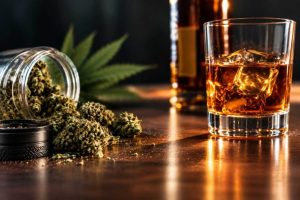
Mixing marijuana and alcohol is now routine
A separate study in JAMA Network Open drew on survey data from 2021 to 2024. Researchers at the National Institute on Drug Abuse found that 49% of adults aged 18 or older who used both marijuana and alcohol in the past month used them simultaneously during their last drinking episode. Instead of swapping one substance for the other, many Americans use both at once.
The pattern was strongest among people with cannabis use disorder. Among those adults, 72.2% of those aged 18 to 29 mixed the two, as did 77.4% of those aged 30 to 49 and 82.0% of those aged 50 or older. The authors pointed to a “normalization of simultaneous use despite potential compounded risks, including impaired judgment, injury, and intoxication effect.” Mixing marijuana and alcohol carries potential compounded risks, and the researchers say so plainly.
Students follow what they believe their peers do
A study in the Journal of American College Health asked 209 college students about alcohol, cannabis and combined use. Every participant had used alcohol only, cannabis only and both in the past year. Students saw alcohol as the most common and most accepted of the three. Yet their beliefs about how common combined use is among peers were the strongest link to how often they combined the two themselves. Beliefs about peer approval showed no link to frequency. Neither type of belief predicted the consequences students reported.
The sample is small, so the findings are a starting point. Still, the authors suggest that interventions could target students’ perceptions of how normal combined use really is. In short, mixing cannabis and alcohol spreads partly because people think everyone else is doing it.
The mental health signals on campus
A survey of 83,467 undergraduates, gathered in 2020 and 2021, tested how alcohol, cannabis and vaping link to depression and anxiety. The sample included 60,746 women and 22,721 men. Researchers compared each group of users with students whose only use was heavy drinking. Students who used both cannabis and vaping devices had the highest odds of depression and anxiety. Among women, the adjusted odds ratios were 1.92 for depression and 1.69 for anxiety. Among men, they were 2.72 and 2.23.
As a result, the picture for students who used cannabis and alcohol alongside vaping is similar, with raised odds. The figures were 1.85 and 1.53 for women and 1.71 and 1.85 for men. The authors noted that the risks were not necessarily additive. These results describe associations, so they cannot prove that use causes either condition. They do show that mixing substances sits alongside poorer mental health in a very large student sample.
What the wider evidence says about homes and laws
Research on legalisation adds another layer. For example, a 2024 longitudinal study pooled three intergenerational samples and linked recreational legalisation to higher teen cannabis use among youth whose parents had used cannabis in their own adolescence. That link did not appear for teens whose parents lacked that history. One systematic review concluded that legalisation tends to increase parental use and approval. It found unclear evidence that legalisation alone worsens parenting or child outcomes, apart from accidental exposures in young children. A national analysis also found no rise in child maltreatment reports after recreational legalisation.
Some caution applies. The parent study relied on surveys that people answered themselves, which can include recall or reporting error. Another parenting study found that children were present in only a small share of use episodes. Even so, clear rules at home, safe storage to keep cannabis away from children, and open talks with teens about expectations remain practical steps while researchers fill the gaps.
The numbers on cannabis and alcohol do not prove harm in every household. They do show that frequent use and mixing have become more visible, and that young people’s habits track what they believe is normal. Overall, adults who set the tone at home and in the community have a say in what that normal looks like.
Dalgarno Institute
Sources:
- Daily Weed Surge Stuns Researchers | Political Insiders
- Marijuana and Alcohol: Half of Co-Users Take Them Together
- Co-use of alcohol and cannabis: Do social norms relate to personal use and consequences among college students?
- Patterns of Alcohol, Cannabis, and E-Cigarette Use/Co-Use and Mental Health Among U.S. College Students